In recent months our focus has been on procedural justice and science-based interviewing practices. We have focused on specific issues, but the key is getting these practices into the hands of interviewers. So, what about interviewee’s lying during the interview? Are we shocked or surprised? Do we fear that lie being placed on the table? We should always expect lies, and frankly, if someone comes in and doesn’t try to lie I am more concerned as to what is going on with them.
I have always taught that it is better to keep the lie from being uttered, because once it is, the interviewee will have to defend it at all costs. I have also taught that it is important to shut down lies. Both concepts need to be re-examined. In this article I am looking at what research and science based interviewing practices say about our response to lying. Do we need to have a broader view of our response to lying, and can they be effectively used to advance the objectives of our interviews.
Again, there are a couple of foundational concepts we must continue to consider. What is our organizational mission? Are we in the interview to get the greatest quantity and quality of truthful information, or a confession? If the number one reason interviewees tell us the truth is the confidence and credibility of the interviewer, what does using legacy and outdated practices with no evidential support result in? The result is the antithesis of our organizational mission and goals. Stop stepping on progress and implement the best practices possible.
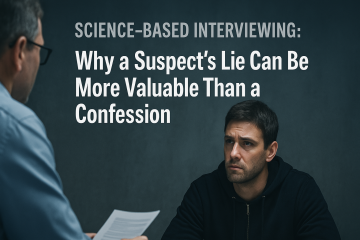
Why a Suspect Lying in an Interview Can Be a Really Good Thing
Let’s talk about something that might sound a little backwards at first: a suspect lying during an interview isn’t just expected—it can actually be a gift. Yep. That moment when someone looks you in the eye and says something you know isn’t true? That’s not a failure of the process. It’s not something to fear or shut down. It’s an opportunity—and sometimes a better one than a confession.
Before we get too deep into why lies matter, let’s talk about the elephant in the room: confessions.
Confessions Are Great—Just Not Everything
There’s no denying that a confession feels like a win. It’s clean, it’s definitive, and it makes for good headlines. If you can get that admission and develop it into a confession, get it. When it comes to investigative outcomes confessions can be very valuable. They can serve to motivate bosses, prosecutors, and administrative decision makers to act, and if I have invested in the investigation, I would like to see effective action on the backside. But the science is clear: while confessions can be useful, chasing them as the main goal can often backfire.
Confession-driven tactics, especially the old-school, legacy, pressure-heavy kind, have been linked to contaminating the integrity of the information you collect—or worse, coercing a false confession. And the science backs this up, big time (Kassin et al., 2010; Meissner et al., 2014). It is a sure way that sends investigations off course. If the goal is simply “get them to say they did it,” you risk missing what actually happened—or worse, punishing the wrong person.
What modern science-based interviewing emphasizes instead is information. The idea is simple: gather as much high-quality, reliable info as possible. And sometimes, that means letting people talk—even when they’re lying.
Why Lies Matter—and How They Help
So why is a lie valuable? Because every time someone tells a story that doesn’t line up with the facts, they give you something to work with.
Let’s break it down. When a suspect lies—especially in a strategic interview setting—it tells us things. Those lies, when matched against the evidence, become what experts call false exculpatory statements. These are denials or stories meant to explain away suspicion, but they don’t hold up under scrutiny. That inconsistency is often just as powerful in court as a confession. By example, let’s say a suspect says they were home all day. You later reveal security footage showing them across town near the crime scene. Their attempt to distance themselves from suspicion is shown to be demonstrably false. And those can be gold in court.
Here’s what makes those lies so useful:
- They highlight inconsistencies between what a person says and what evidence shows.
- They reveal intent—why lie unless you’re trying to cover something up?
- They show consciousness of guilt—in some jurisdictions, that lie can be introduced as evidence in itself.
- They avoid the pitfalls of coercion, since the person offered the false story voluntarily.
Best of all? Studies like those by Brimbal & Jones (2018) show that jurors respond strongly to “proven lies.” In fact, when suspects make statements that are later contradicted by solid evidence, jurors are just as likely to convict as they are when hearing a confession.
Let the Lie Breathe—Strategically
Science-based interviewing techniques—especially the Strategic Use of Evidence (SUE) technique—are at the heart of this shift. Rather than confront, accuse, and break a suspect down, SUE works with psychology. It uses a subtle, escalating approach: let the suspect talk, gather their version of events, and then, slowly and methodically, introduce evidence that exposes inconsistencies (Hartwig et al., 2005, 2006, 2014).
Here’s how SUE works:
- Get their story first. Let the suspect talk without interruption. The goal is to lock them into a version of events.
- Start broad, go narrow. Ask open-ended questions first, then tighten the focus as the interview progresses.
- Reveal evidence gradually. Don’t slap down the security footage in minute one. Start vague (“Do you recall leaving your home?”) and save the hard proof (“Here’s a video of you at the scene.”) for later.
- Stay calm and non-judgmental. When the contradictions start showing, ask for clarification, not confrontation. The goal isn’t to catch them in a “gotcha”—it’s to give them the chance to explain… or dig the hole deeper.
This “drip-drip-drip” approach locks the suspect into their story. When the interviewer eventually presents contradicting evidence, the subject’s lie gets spotlighted—not because they were bullied into slipping up, but because they were encouraged to speak freely, and they chose to lie. This creates a powerful contrast between the lie and the truth.
Lies Don’t Always Mean Guilt—But They Always Mean Something
Not every lie means the person committed the crime. People lie for lots of reasons: fear, embarrassment, protecting someone else, even poor memory. That’s why science-based interviewing focuses on understanding the lie, not just confronting it.
Here are a few ways lies can still be useful, even if they don’t lead to a conviction:
- Eliminating suspects: A lie might be about something unrelated, but clearing up that detail could exonerate the person entirely.
- Revealing motives or relationships: A suspect lying about knowing the victim might reveal a hidden connection worth exploring to fully develop the case.
- Identifying deception strategies: Some suspects repeat the same types of lies—those patterns can be used in future interviews or linked to behavior in other cases.
- Strengthening corroboration: A lie disproven by witness accounts, GPS data, or surveillance footage adds credibility to that evidence.
So, while not every lie means guilt, every lie gives you something—a thread to pull, a lead to follow, or a story to double-check.
Here’s the deal: suspects lie. It’s part of the game. But when we stop seeing lies as failures and start seeing them as data points, we get better interviews, stronger cases, and more ethical investigations. Interviewers no longer must choose between getting a confession and getting useful information—they can get both, or just as powerfully, a lie that proves the truth.
A Better Way Forward
The future of suspect interviewing isn’t about turning up the heat. It’s about turning up the listening. Let suspects talk. Give them room to lie. Then use strategy, evidence, and calm persistence to separate truth from fiction.
Lies don’t derail good interviews—they reveal them. They aren’t the enemy of justice; they’re evidence of guilt, wrapped in denial. When handled properly, they’re just as powerful as confessions—sometimes even more so.
Confessions still matter—but they shouldn’t be the only measure of success. When you build a case around the full picture, not just a single statement, you get stronger investigations, less misleading information, and fewer wrongful convictions.
And the next time someone lies in the interview room? Take a breath. That’s not the end of the road. It might be the beginning of your strongest case yet.
These science-based practices must be fully implemented in our interview approach. Time for reflection! Are you employing these practices, If not, why not? Ask yourself why you are doing what you are doing? Do you have any proof that supports your legacy practices and the outcomes they produce? Is your approach maximizing the quality and quantity of truthful information obtained? It is time to change and the changes that are needed are fundamental and can be accomplished in a timely and effective manner.
Training is essential! It is what moved me beyond my blind spots, at least some of them. I can provide the training or recommend providers teaching science-based techniques. Do your research, find the right provider, maximize your training dollar investment. If you are a practitioner or a leader, don’t get the same old legacy-based methods that have no empirical evidence supporting them. If you are in leadership, you have the same responsibility to know and apply these standards and find that content that maximizes your team’s effectiveness.
Anderson Investigative Associates is positioned to custom-tailor training to your specific needs. If you have any questions or would like to discuss the multiple benefits of lies in the interview room, or any training need, please reach out. Additional issues pertaining to interviewing, auditing, and investigations can be found in other blogs and videos that I have produced and are contained in most blocks of instruction that our company presents.
If you have additional questions, comments, or have an interview topic you would like me to address, just let me know. In the meantime, be well, stay safe out there, and happily greet the next lie that comes your way. Is it time to improve your interviewing and communication skills, and not just in interviews but throughout your life. If you need help getting ready, I know who could help.
Further Reading:
- Hartwig et al. (2005, 2006, 2014, 2023) – Strategic Use of Evidence (SUE) research.
- Brimbal & Jones (2018) – The power of proven lies in court.
- Meissner et al. (2014) – Meta-analysis of interrogation techniques.
- Kassin et al. (2010) – The risks of confession-oriented methods.
Mark A. Anderson
Director of Training and Development
Anderson Investigative Associates, llc
114 Loucks Avenue
Scottdale, PA 15683
manderson@andersoninvestigative.com
tel:912-571-6686