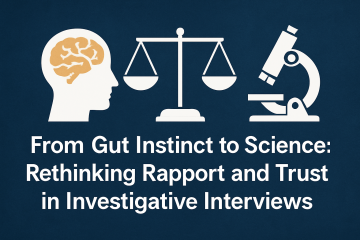
In recent months our focus has been on procedural justice and science-based interviewing practices. We have focused on specific issues, but the key is getting these practices into the hands of interviewers. In this blog, I want to explore the issue of rapport and its inextricable connection with trust. In training I have seldom seen these broken out, but research directs that we understand them and be effective at implementing both.
With this subject, the qualities of credibility and authenticity enter in. In establishing rapport and trust, if you can’t do it with sincerity and some strategic empathy, you best not do it. Results will not be consistent with research if this is merely an Oscar performance. Always remember the importance of credibility and competence.
Again, there are a couple of foundational concepts we must consider. What is your organizational mission? Are you in the interview to get the greatest quantity and quality of truthful information? If the number one reason interviewees tell us the truth is the confidence and credibility of the interviewer, what does using legacy and outdated practices with no evidential support result in? The result is the antithesis of our organizational mission and goals. Stop stepping on progress and implement the best practices possible and available.
In investigative interviews, we hear a lot about building rapport and gaining trust. Sometimes they’re treated like the same thing—but they’re not. Understanding the difference (and how they connect) is critical if you want to get reliable information and maintain ethical integrity.
Let’s break this down and talk about how science-based interviewing and procedural justice go hand in hand to level up your interviews.
Rapport: Your First Step Through the Door
Rapport is the groundwork. It’s about creating a respectful, human-to-human connection. You’re showing the interviewee that you see them as more than just a case file. You’re listening actively, being patient, and treating them with decency.
It might seem “soft,” but the effects are anything but. Studies have shown that when rapport is done right—when interviewers are present, nonjudgmental, and genuinely engaged—people are way more likely to open up and provide accurate information. That first impression matters.
Rapport-building isn’t just about being friendly—it’s a strategic tool. Studies show that when interviewers use rapport-based techniques like active listening, open-ended questions, and empathy, interviewees are more likely to cooperate and disclose accurate information.
In fact, a 2021 training study with law enforcement officers found that those who adopted evidence-based rapport tactics saw increases in both perceived rapport and trust from interviewees, which in turn led to more cooperation and information disclosure.
Even in virtual settings—where body language cues are limited—rapport still matters. A 2022 study found that participants in rapport-based virtual interviews provided more accurate details and engaged in more dialogue than those in no-rapport conditions.
And that leads us into trust.
Trust: What Keeps the Door Open
While rapport can be built relatively quickly, trust takes time and consistency. It’s reinforced when interviewers follow through on promises, avoid deception, and treat interviewees with respect. Trust is always important but especially crucial when dealing with sensitive topics or vulnerable populations.
Trust goes deeper. It’s the belief that you’re going to treat the person fairly, keep your word, and use what they share responsibly. While rapport might get someone talking, trust is what keeps them talking.
Here’s where procedural justice really shines. This concept comes from legal and policing research, and it’s all about how people perceive fairness in the way they’re treated—regardless of the outcome. Even if things don’t go their way, if they feel they were heard, treated with respect, and that the process was fair, they’re more likely to comply and cooperate.
That exactly lines up with science-based interviewing:
- You’re transparent about what’s happening.
- You’re consistent in your tone and behavior.
- You give the interviewee space to speak freely.
- You treat every person with dignity, whether they’re a victim, witness, or suspect.
And surprise: when people feel respected and in control, they trust more—and the quality of information you get skyrockets. Research indicates that when interviewees trust their interviewer, they’re more likely to share accurate and detailed information. This trust is fostered through consistent rapport-building and ethical interviewing practices.
Science-Based Interviewing: Ethical, Effective, and Fair
Science-based interviewing (SBI) is built around what works—what actually leads to truthful, reliable disclosures, not “getting a confession” as the primary objective. It leaves behind coercion, deception, manipulation, and pressure tactics that not only hurt people, but lead to bad outcomes (false confessions, poor intel, you name it). It draws from cognitive psychology and communication research to create interviews that are ethical, effective, and reliable.
Instead, SBI leans into:
- Memory-based questioning (instead of leading questions)
- Open-ended prompts
- Empathy, patience, and rapport-building
- Respectful, fair treatment across the board
Sound familiar? It’s procedural justice in action.
In fact, modern research is showing that these principles don’t just make interviews more ethical—they make them more effective. Whether in law enforcement, military settings, or private sector investigations, science-based techniques are delivering better results without sacrificing human dignity.
The Takeaway: Rapport Starts the Conversation, Trust Makes It Count
So, here’s the deal: rapport is about connection, trust is about credibility, and both are built stronger when we treat people fairly.
The more we embrace the science—the evidence of what actually works—the better our interviews get. And as a bonus? We’re creating a more just, humane process while we’re at it.
Let’s leave behind outdated methods and move forward with integrity. Build rapport. Earn trust. And let science guide the way.
Want help training your team in science-based techniques or want to dig into the research behind this? Just ask—I’ve got you.
These science-based practices must be fully implemented in our interview approach. Please reflect! Are you employing these practices, If not, why not? Ask yourself why you are doing what you are doing? Do you have any proof that supports your legacy practices and the outcomes they produce? Is your approach maximizing the quality and quantity of truthful information obtained? It is time to change! The changes that are needed are fundamental and can be accomplished in a timely and effective manner.
Training is essential! It is what moved me beyond my blind spots, (at least some of them). I can provide the training or recommend providers teaching science-based techniques. Do your research, find the right provider, maximize your training dollar investment. If you are a practitioner or a leader, don’t get the same old legacy-based methods that have no empirical evidence supporting them. If you are in leadership, you have the same responsibility to know and apply these standards and find that training content that maximizes your team’s effectiveness and accomplishes your mission.
Anderson Investigative Associates is positioned to custom-tailor training to your specific needs. If you have any questions or would like to discuss the subject of rapport and trust, or any training need, please reach out. Additional issues pertaining to interviewing, auditing, and investigations can be found in other blogs and videos that I have produced and are contained in most blocks of instruction that our company presents.
If you have additional questions, comments, or have an interview topic you would like me to address, just let me know. In the meantime, be well, stay safe out there, and apply quality rapport and trust building in every area of your life. Is it time to improve your interviewing and communication skills, and not just in interviews but throughout your life. If you need help getting ready, I know who could help.
Further Reading:
- Brimbal, L., et al. (2021). Evaluating the benefits of a rapport-based approach to investigative interviews: A training study with law enforcement investigators. PubMed+1National Policing Institute+1
- Meijer, E. H. H., et al. (2022). The Effects of Rapport Building on Information Disclosure in Virtual Interviews. ResearchGate+3PMC+3PubMed+3
- Vallano, J. P., & Compo, N. S. (2011). Building trust with cooperative witnesses in a crime investigation. ScienceDaily+1PMC+1
- The SBI Academy. (n.d.). What is Science-Based Interviewing. The SBI Academy
Mark A. Anderson
Director of Training and Development
Anderson Investigative Associates, llc
114 Loucks Avenue
Scottdale, PA 15683
manderson@andersoninvestigative.com
tel:912-571-6686