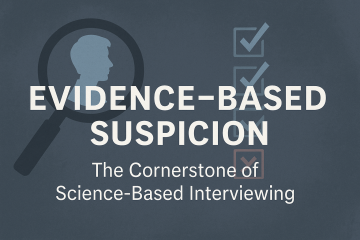
In recent months our focus has been on procedural justice and science-based interviewing practices. We have focused on specific issues, but the key is getting these practices into the hands of interviewers. In this blog, I want to explore the issue of evidence-based suspicion and its importance in the arena of science-based interviewing. This topic requires some self-reflection and evaluation of your critical thinking skills in the investigative and interviewing planning and preparation you do.
There are a couple of foundational concepts we must consider. What is your organizational mission? Are you in the interview to get the greatest quantity and quality of truthful information? If the number one reason interviewees tell us the truth is the confidence and credibility of the interviewer, what does using legacy and outdated practices with no evidential support result in? The result is the antithesis of our organizational mission and goals. Stop stepping on progress and implement the best practices possible and available. And here is another to improve your techniques:
What Is Evidence-Based Suspicion?
In the world of science-based interviewing, evidence-based suspicion is a simple but powerful idea: you form suspicions only when they’re grounded in observable, verifiable data—not instincts, stereotypes, or outdated “tells.” It’s about letting science—not gut feelings—guide your decision-making when you’re evaluating credibility, intent, or potential deception. And recognize with evidence, some is given more weight than others and that critical analysis must consistently happen.
This concept has become increasingly important in law enforcement, intelligence, and corporate settings, where interviews are often high-stakes. And while our instincts might be great for surviving in the wild, they’re not particularly great at detecting lies or hidden motives—especially across cultural or emotional contexts.
Why Evidence-Based Suspicion Matters
- Improves Accuracy and Reduces Errors
Humans are notoriously bad at detecting deception. In a large meta-analysis of over 200 studies, Bond and DePaulo (2006) found that people average only 54% accuracy in distinguishing lies from truth—basically, a coin flip. Even professionals like police officers and judges didn’t fare significantly better unless they relied on scientifically validated strategies.
By shifting to evidence-based indicators—like inconsistencies between a person’s statement and known facts—interviewers can move beyond gut feeling and increase the reliability of their suspicions.
- Reduces False Positives (and the Damage They Cause)
When suspicion is formed based on intuition or pseudoscience (like assuming liars avoid eye contact), the chances of a false positive—believing someone is lying when they’re not—go way up. This can lead to:
- Wrongful accusations
- Damaged reputations
- Legal liability
- Distrust within teams or communities
Evidence-based suspicion introduces a higher standard of proof, reducing these risks and protecting both interviewers and subjects from unnecessary harm.
- Encourages Ethical and Transparent Interviewing
Science-based interviewing emphasizes respect, fairness, and transparency—values supported by the use of evidence-based suspicion. When interviewees know that judgments are made based on facts, not feelings, they’re more likely to:
- Cooperate
- Disclose truthfully
- View the process as fair and legitimate
This is especially important in public service roles, where procedural justice builds trust and cooperation with communities.
- Helps Avoid Confirmation Bias
Once we suspect someone of being dishonest, it’s easy to fall into confirmation bias—where we only look for evidence that supports our suspicion. Evidence-based interviewing techniques interrupt that bias by requiring interviewers to seek out both confirming and disconfirming evidence before drawing conclusions.
Granhag and Hartwig (2008) explored how investigative interviewers can avoid such biases by training in strategic use of evidence (SUE)—a technique grounded in evidence-based suspicion. When used properly, it leads to more disclosures and fewer false admissions. It also improves accuracy and decreases errors.
- Adds Credibility to the Interview Process
In high-stakes environments, your decisions might be reviewed by supervisors, lawyers, or courts. Suspicions based on validated cues (like statement inconsistencies or fact-checkable contradictions) are far more defensible than those based on body language myths or “gut feelings.”
This makes your process not only more ethical, but also more professional and legally sound.
The Risks of Ignoring Evidence-Based Suspicion
Let’s flip the coin. What happens when we don’t use evidence-based suspicion, which many of you, like me, should be aware of from past practice?
- Misinterpretation of Behavior
People display nervousness for many reasons—anxiety, culture shock, past trauma—not necessarily guilt. Without a strong evidentiary basis, nervous behavior can easily be misread. This is especially problematic in cross-cultural interviews where body language norms vary.
Vrij et al. (2010) caution against overreliance on nonverbal cues, emphasizing that behavioral indicators alone are poor predictors of deception. It’s the content and context of speech, compared against verifiable facts, that hold the most value.
- Reliance on Pseudoscience
Pop psychology has done real damage in the interviewing world. Ideas like “liars touch their face” or “liars always look away” are still widespread despite being debunked. Continuing to rely on these ideas reinforces harmful stereotypes and leads to biased or discriminatory interviews.
- Interview Contamination and Tunnel Vision
If suspicion forms early without solid grounding, the rest of the interview can become skewed. You start asking leading questions, cherry-picking responses, or overlooking honest answers. This “tunnel vision” effect narrows the scope of inquiry and destroys the integrity of the interview.
- Poor Case Outcomes
Whether you’re building a legal case, assessing a candidate, or evaluating intelligence, a decision made on flawed suspicion is a decision on a shaky foundation. When evidence-based suspicion is missing, the entire outcome becomes vulnerable to challenge—by defense attorneys, journalists, auditors, or simply reality.
So, What Does the Research Say?
Here are some key findings and frameworks that support the concept of evidence-based suspicion:
- Bond & DePaulo (2006): Found minimal difference between truth detection and guessing, highlighting the need for structured, evidence-based techniques.
- Vrij, A. (2008, 2010): Emphasizes the importance of verbal cues over nonverbal behavior in detecting deception. Nonverbal cues are poor.
- Granhag & Hartwig (2008): Introduced the SUE technique, showing how disclosure of evidence at strategic points improves information gain and deception detection.
- Hartwig et al. (2005): Demonstrated that trained interviewers using strategic evidence could significantly outperform untrained peers in lie detection.
- The High-Value Detainee Interrogation Group (HIG): Supports evidence-based interviewing approaches that prioritize rapport and fact-based information elicitation over coercion or hunch-based methods.
Final Thoughts
In a world where our decisions as interviewers can change lives, careers, or cases, the responsibility to get it right is enormous. Evidence-based suspicion helps us rise to that responsibility. We owe it to those we encounter, to those we serve, and possibly most importantly to ourselves if integrity is a core value.
It doesn’t mean ignoring intuition altogether—it means testing it. Validating it. Grounding it. And when we do that, we create interviews that are not only more accurate but also more ethical, defensible, accurate, and human.
So, the next time something feels “off” in an interview, take a breath—and look for the evidence. It’s not just good practice. It’s smart ethical interviewing.
These science-based practices must be fully implemented in our interview approach. Please reflect! Are you employing these practices, If not, why not? Ask yourself why you are doing what you are doing? Do you have any proof that supports your legacy practices and the outcomes they produce? Is your approach maximizing the quality and quantity of truthful information obtained? It is time to change! The changes that are needed are fundamental and can be accomplished in a timely and effective manner.
Training is essential! It is what moved me beyond my blind spots, (at least some of them). I can provide the training or recommend providers teaching science-based techniques. Do your research, find the right provider, maximize your training dollar investment. If you are a practitioner or a leader, don’t get the same old legacy-based methods that have no empirical evidence supporting them. If you are in leadership, you have the same responsibility to know and apply these standards and find that training content that maximizes your team’s effectiveness and accomplishes your mission.
Anderson Investigative Associates is positioned to custom-tailor training to your specific needs. If you have any questions or would like to discuss the subject of evidence-based suspicion, or any training need, please reach out. Additional issues pertaining to interviewing, auditing, and investigations can be found in other blogs and videos that I have produced and are contained in most blocks of instruction that our company presents.
If you have additional questions, comments, or have an interview topic you would like me to address, just let me know. In the meantime, be well, stay safe out there, and start implementing the tenets of evidence-based suspicion in your interviewing and in every area of your life. Is it time to improve your interviewing and communication skills, and not just in interviews but throughout your life. If you need help getting ready, I know who could help.
Further Reading:
- Bond, C. F., & DePaulo, B. M. (2006). Accuracy of deception judgments. Personality and Social Psychology Review, 10(3), 214–234.
- Vrij, A. (2008). Detecting Lies and Deceit: Pitfalls and Opportunities (2nd ed.). Wiley.
- Vrij, A., Fisher, R. P., Mann, S., & Leal, S. (2010). A cognitive approach to lie detection: A meta-analysis. Legal and Criminological Psychology, 15(1), 57–75.
- Granhag, P. A., & Hartwig, M. (2008). A new theoretical perspective on deception detection: On the psychology of instrumental mind-reading. Psychology, Crime & Law, 14(3), 189–200.
- Hartwig, M., Granhag, P. A., Strömwall, L. A., & Kronkvist, O. (2005). Strategic use of evidence during police interviews: When training to detect deception works. Law and Human Behavior, 30(5), 603–619.
- Meissner, C. A., Redlich, A. D., Bhatt, S., & Brandon, S. (2021). Science-based interviewing: Implications for law enforcement and national security. American Psychologist, 76(5), 709–723.
Mark A. Anderson
Director of Training and Development
Anderson Investigative Associates, llc
114 Loucks Avenue
Scottdale, PA 15683
manderson@andersoninvestigative.com
tel:912-571-6686