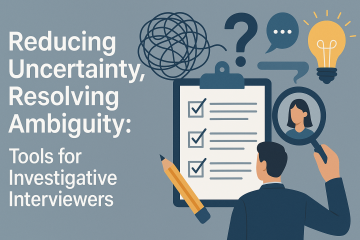
Over the last several weeks our focus has been on procedural justice and science-based interviewing practices. We have focused on specific issues, but the key is getting these practices into the hands of interviewers. This past week I read an excellent article by Colton Seale entitled, “Are You Facing Uncertainty or Ambiguity and Why it Matters” which made me consider the topic from a day to day and a leadership perspective. The more I considered it, I questioned whether we miss this distinction in the interview room.
If we are missing it, what does that mean from the perspective of our interview results? Lack of awareness of the difference or listening for that difference could be detrimental to both the quality and quantity of information that we obtain. Worse yet, we could end up with skewed results that could focus us in an unproductive investigative direction. It is key to understanding the difference and adjust and adapt our approach to addressing both ambiguity and uncertainty.
Again, there are a couple of foundational concepts we must ponder. What is our organizational mission? Are we in the interview to get the greatest quantity and quality of truthful information? If the number one reason interviewees tell us the truth is the confidence and credibility of the interviewer, what does using legacy and outdated practices with no evidential support result in? The result is the antithesis of our organizational mission and goals. Stop stepping on progress and implement the best practices possible.
In the context of science-based, non-confrontational investigative interviewing, distinguishing between uncertainty and ambiguity is crucial for effective and complete information gathering. The differences between these two influence the strategies employed to elicit reliable and comprehensive responses from interviewees.
Understanding Uncertainty and Ambiguity
- Uncertainty refers to situations where the potential outcomes and influencing factors are unclear but can be modeled or estimated based on available data or evidence. In investigative interviewing, uncertainty manifests when the interviewer lacks concrete information about an event’s specifics but has methodologies to reduce this uncertainty through existing evidence and systematic questioning.
- Ambiguity arises when multiple interpretations exist for a particular situation, making it difficult to discern the actual cause or motivation behind an event. In interviews, ambiguity is prevalent when there are conflicting accounts, vague statements, or unclear motives, requiring inference and analysis to reach a plausible conclusion. Again, dialogue, rapport, and quality questioning become essential.
Mitigating Uncertainty in Investigative Interviews
To reduce uncertainty, interviewers rely on structured techniques that extract reliable and corroborated information:
- Cognitive Interviewing – This method enhances recall accuracy by helping interviewees reconstruct events through context reinstatement, varied retrieval, and multiple perspectives.
- Example: A witness is unsure whether they saw a red or blue car at a crime scene. Using cognitive interviewing, the investigator asks them to mentally place themselves back at the scene, describe their surroundings, and consider peripheral details like reflections or lighting conditions, helping to resolve the uncertainty.
- Fact Verification and Cross-Referencing – Using established facts and cross-checking with other evidence helps narrow down uncertain elements of a case and explanations provided.
- Example: A suspect claims to have been at a coffee shop during the time of a robbery. Investigators reduce uncertainty by checking security footage, transaction records, and phone location data to verify their claim.
- Science-Based Models – Bayesian inference and probability modeling can be applied to weigh the likelihood of different accounts based on past patterns and empirical data.
- Bayesian inference involves updating the probability of a hypothesis as more evidence or information becomes available. In investigative settings, this might involve revising the likelihood of a suspect’s guilt based on new alibi evidence. This procedure helps to mitigate possible biases that can effect clarity.
- Probability modeling uses statistical frameworks to estimate the likelihood of events, helping investigators manage uncertainty through quantifiable data.
- Open-Ended Questioning – Encouraging free recall reduces the risk of suggestibility and enables the collection of untainted responses that contribute to resolving unknowns.
Resolving Ambiguity in Investigative Interviews
Ambiguity presents a greater challenge as it involves subjective interpretations and motivations that cannot be easily measured. To manage ambiguity, interviewers should use the following approaches:
- Clarifying the Question – Ensuring the purpose of inquiry is clearly defined helps in formulating precise questions that target the core issue. Effective dialogue helps to establish this.
- Example: A suspect provides multiple, seemingly unrelated reasons for their presence at a crime scene. The investigator clarifies by asking, “What was your primary reason for being there?” to pinpoint their motivation.
- Delineating Facts from Inferences – Separating verified facts from opinions or unverified statements prevents cognitive biases from clouding judgment. This should be done consistently in your assessment.
- Analyzing Patterns of Speech and Behavior – Ambiguity can often be reduced by identifying inconsistencies, behavioral cues, and linguistic markers that reveal intent. Identification of these only occurs through effective listening, being fully present.
- Example: A subject denies knowing a victim but later refers to them by a nickname. The inconsistency suggests a need for further questioning to clarify their relationship.
- Exploring Alternative Explanations – A systematic assessment of possible motives using causal reasoning frameworks, such as causal overshadowing and inferential discomfort, helps interviewers assess the most plausible explanations.
- Causal overshadowing occurs when multiple possible causes are presented, making it difficult to determine which is the most likely or influential. Interviewers must work to identify which cause carries the most explanatory weight. Good questioning can accomplish that.
- Inferential discomfort refers to the unease or cognitive strain experienced when forming conclusions under ambiguous circumstances, knowing that competing explanations exist. Investigators must tolerate this discomfort while rigorously testing each hypothesis through continued rapport and quality questioning.
- Example: A suspect confesses but provides multiple, conflicting reasons for their actions. By analyzing their statements in relation to external evidence, an investigator can determine whether their confession is coerced, fabricated, or genuine.
- Strategic Questioning – Techniques such as the “Think-Aloud Protocol” or “Perspective Taking” encourage subjects to articulate reasoning, offering deeper insight into ambiguous situations.
- Think-Aloud Protocol involves asking the subject to verbalize their thought process while describing an event or making a decision. This reveals internal reasoning and helps clarify ambiguous motivations. If they are being disingenuous, that can become clear in their answers.
- Perspective Taking asks the subject to consider and explain how another person might perceive the same event, shedding light on relational dynamics or unspoken intentions.
Applications in Real-World Investigations
In forensic, investigative, and intelligence settings, differentiating uncertainty from ambiguity is essential for constructing reliable narratives.
- Example of Uncertainty: A missing person’s last known location is unclear. Investigators use phone records, CCTV footage, and eyewitness accounts to establish their movements before disappearance, systematically reducing the uncertainty of their location.
- Example of Ambiguity: A suspect claims to have fled a crime scene out of fear but also states they did not witness any violence. Investigators must explore whether the fear was justified, whether the suspect is concealing information, or whether their reasoning is fabricated, addressing the ambiguity through careful questioning and behavioral analysis.
Conclusion
Science-based, non-confrontational investigative interviewing effectively navigates uncertainty through structured evidence collection and modeling while addressing ambiguity through inference and critical analysis. Recognizing and applying the appropriate strategies for each challenge enhances the reliability of investigative findings and reduces cognitive biases in the decision-making process. Any process that brings clarity to the information provided meets the organizational objective of obtaining the highest quality and quantity of truthful information.
Science-based practices must be fully implemented in our interviewing approach. Time for introspection! Are you employing these practices, If not, why not? Ask yourself why you are doing what you are doing? Do you have any proof that supports your legacy practices and the outcomes they produce? Is your approach maximizing the quality and quantity of truthful information obtained? It is time to change and the changes that are needed are fundamental and can be accomplished in a timely and effective manner.
Training is essential! It is what moved me beyond my blind spots, at least some of them. I can provide the training or recommend providers teaching science-based techniques. Do your research, find the right provider, maximize your training dollar investment. If you are a practitioner or a leader, don’t get the same old legacy-based methods that have no empirical evidence supporting them. If you are in leadership, you have the same responsibility to know and apply these standards and find that content that maximizes your team’s effectiveness.
Anderson Investigative Associates is positioned to custom-tailor training to your specific needs. If you have any questions or would like to discuss the issues of uncertainty and ambiguity, or any training need, please reach out. Additional issues pertaining to interviewing, auditing, and investigations can be found in other blogs and videos that I have produced and are contained in most blocks of instruction that our company presents.
If you have additional questions, comments, or have an interview topic you would like me to address, just let me know. In the meantime, be well, stay safe out there, and it’s time to reevaluate your approach to effective interviewing. Is it time to improve your interviewing and communication skills, and not just in interviews but throughout your life. If you need help getting ready, I know who could help.
References
- Fisher, R. P., & Geiselman, R. E. (1992). Memory-enhancing techniques for investigative interviewing: The cognitive interview. Charles C Thomas Publisher.
- Vrij, A. (2008). Detecting Lies and Deceit: Pitfalls and Opportunities. John Wiley & Sons.
- Kahneman, D. (2011). Thinking, Fast and Slow. Farrar, Straus and Giroux.
- Tversky, A., & Kahneman, D. (1974). Judgment under uncertainty: Heuristics and biases. Science, 185(4157), 1124-1131.
Mark A. Anderson
Director of Training and Development
Anderson Investigative Associates, llc
114 Loucks Avenue
Scottdale, PA 15683
manderson@andersoninvestigative.com
tel:912-571-6686