Over the last several weeks our focus has been on procedural justice and science-based interviewing practices. We have focused on specific issues, but the key is getting these practices into the hands of interviewers. One of the questions I am often asked because of the number of law enforcement officers I have interviewed as subjects in investigations, is how that changes the interview you prepare for and conduct.
I believe there are minor adjustments and personalization’s we must make for any interview, but science-based techniques are psychologically sound to facilitate success across the board. In this article I am looking at differences when interviewing laypeople (without understanding the interviewing process) and investigators (with background and training in the interviewing arena). I use the term investigator referring to law enforcement officers, investigators, or essentially anyone that understands the interview process (or thinks they do).
Again, there are a couple of foundational concepts we must continue to consider. What is our organizational mission? Are we in the interview to get the greatest quantity and quality of truthful information? If the number one reason interviewees tell us the truth is the confidence and credibility of the interviewer, what does using legacy and outdated practices with no evidential support result in? The result is the antithesis of our organizational mission and goals. Stop stepping on progress and implement the best practices possible.
Introduction
Science-based investigative interviewing emphasizes evidence-based techniques to obtain accurate, reliable, and complete information from interviewees. Rooted in psychological principles and decades of empirical research, protocols such as the Cognitive Interview (Fisher & Geiselman, 1992), the NICHD protocol for child interviews (Lamb et al., 2018), and many other diverse studies underscore principles like rapport-building, open-ended questioning, and the avoidance of leading or coercive tactics.
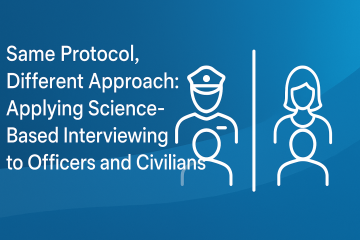
When applying these protocols, important distinctions arise between interviewing trained law enforcement professionals and laypeople. These differences stem from cognitive, experiential, and attitudinal factors, necessitating tailored approaches to maximize the effectiveness, completeness, and fairness of interviews.
Key Differences in Interviewing Law Enforcement Officers/Investigative Personnel vs. Laypeople
- Subject Matter Knowledge and Expectations
- Law Enforcement Officers/Investigative Personnel (Investigators):
Investigators typically have substantial familiarity with investigative procedures, legal frameworks, and the expectations of an interview. This knowledge may lead them to anticipate questions, tailor responses, or even unconsciously filter details they assume are irrelevant or already known. This can mask results in many ways. - Laypeople:
In contrast, laypeople may lack awareness of investigative goals, feel uncertain about what is important to report, and may need more encouragement to share narrative accounts freely.
Interviewing Implication:
Interviewers must be careful not to assume completeness or accuracy merely because the subject is trained. With investigators, interviewers should explicitly instruct that all details are important, regardless of perceived relevance. It will be essential to have well-formulated questions to elicit a full account.
- Cognitive Load and Recall
- Investigators:
Officers may engage in “schematization” — relying on professional scripts or routines when recalling events (e.g., standard report-writing language). This frequently will lead to the omission of unique or context-specific details necessary for a complete investigation. - Laypeople:
Laypeople often recall events more idiosyncratically and may include more sensory or emotional details, albeit sometimes disorganized or less coherent.
Interviewing Implication:
Science-based techniques like the Cognitive Interview help both groups but may need adaptation. With investigators, using context reinstatement and timeline reversal can disrupt script-based recall and elicit more granular detail.
- Power Dynamics and Social Role Perception
- Investigators:
Investigators are typically accustomed to being in the role of interviewer, not interviewee. This reversal can cause discomfort, guardedness, or attempts to control the interview. As the interviewer it is important to demonstrate credibility. - Laypeople:
Laypeople often defer to the authority of the interviewer, which can make them overly compliant or hesitant.
Interviewing Implication:
Building rapport and establishing neutrality is critical in both cases. With investigators, the interviewer must normalize the process and reduce perceived threats to professional identity. With laypeople, emphasis should be placed on empowerment and trust.
- Response Strategies and Motivation
- Investigators:
Investigators may be more guarded if the interview pertains to a use-of-force incident, misconduct, or an internal investigation. They may be concerned about legal or reputational consequences. In today’s times these can be overwhelming. - Laypeople:
While they may also be concerned about consequences, laypeople often prioritize emotional relief or moral obligation to share what they know.
Interviewing Implication:
Science-based protocols emphasize non-accusatory approaches and truth-seeking over confession-seeking. This is especially important when interviewing law enforcement to avoid resistance or defensiveness. This needs to be consistent across the board in every interview.
- Metacognitive Confidence and Source Monitoring
- Investigators:
Investigators often exhibit high confidence in their recall, regardless of actual accuracy. Their familiarity with procedural environments can lead to overconfidence and less reflection on the source of memory (e.g., firsthand vs. secondhand knowledge). - Laypeople:
Laypeople may be less confident, more willing to express uncertainty, and more open about source ambiguity.
Interviewing Implication:
Interviewers should encourage reflection and caution against overstatement. Instructions about reporting uncertainty and “don’t know” responses being acceptable are critical — especially for investigators who may conflate certainty with credibility. This process needs to be managed through effective rapport, good questions, and strategic empathy.
- Strategic Disclosure of Evidence (SUE Technique)
- Investigators:
Investigators are often highly attuned to how evidence is typically gathered and used. When being interviewed, they may actively try to anticipate what evidence the interviewer possesses, potentially shaping their responses to align with or deflect from it. They may also recognize evidence disclosure patterns if done too early, which can reduce the effectiveness of the interview. - Laypeople:
Civilians are generally less familiar with how evidence is handled in investigative interviews. They are less likely to recognize when an interviewer is withholding or strategically disclosing information, and more likely to provide spontaneous contradictions if they are deceptive.
Interviewing Implication:
The SUE technique is particularly effective when used judiciously with experienced individuals like law enforcement officers. Rather than disclosing evidence early, interviewers should allow interviewees to commit to a narrative and then later present the evidence to assess consistency and credibility. This helps avoid tipping off the subject and maintains the integrity of the interview. With civilians, SUE can still be effective but is often used more simply and cautiously to avoid intimidation or confusion. Planning and preparation are essential to prepare for how and what will be disclosed.
Best Practices and Recommendations
- Customized Pre-Interview Instructions:
Clarify the importance of detailed narrative, uncertainty acceptance, and non-evaluative listening, especially with investigators who may otherwise default to brevity or formality. - Neutral, Open-Ended Questions:
Avoid suggestive or leading questions. Use prompts like “Tell me everything you remember about…” followed by focused elaboration prompts. - Reinstate Context Effectively:
Use sensory-based context reinstatement and allow mental rehearsal, particularly helpful to overcome script-based reporting. - Establish Non-Threatening Atmosphere:
Emphasize collaboration and information-gathering rather than scrutiny — essential when interviewing fellow professionals.
Conclusion
Interviewing investigative personnel requires adjustments grounded in the same science-based principles used for interviewing laypeople, but with attention to role, training, cognitive patterns, and social dynamics. By respecting these differences while adhering to science-based interviewing techniques, interviewers can enhance the reliability of information gathered from both groups.
These science-based practices must be fully implemented in our interviewing approach. Time for introspection! Are you employing these practices, If not, why not? Ask yourself why you are doing what you are doing? Do you have any proof that supports your legacy practices and the outcomes they produce? Is your approach maximizing the quality and quantity of truthful information obtained? It is time to change and the changes that are needed are fundamental and can be accomplished in a timely and effective manner.
Training is essential! It is what moved me beyond my blind spots, at least some of them. I can provide the training or recommend providers teaching science-based techniques. Do your research, find the right provider, maximize your training dollar investment. If you are a practitioner or a leader, don’t get the same old legacy-based methods that have no empirical evidence supporting them. If you are in leadership, you have the same responsibility to know and apply these standards and find that content that maximizes your team’s effectiveness.
Anderson Investigative Associates is positioned to custom-tailor training to your specific needs. If you have any questions or would like to discuss the dynamics of investigator vs. laypeople interviewing, or any training need, please reach out. Additional issues pertaining to interviewing, auditing, and investigations can be found in other blogs and videos that I have produced and are contained in most blocks of instruction that our company presents.
If you have additional questions, comments, or have an interview topic you would like me to address, just let me know. In the meantime, be well, stay safe out there, and it’s time to reevaluate your approach to effective interviewing. Is it time to improve your interviewing and communication skills, and not just in interviews but throughout your life. If you need help getting ready, I know who could help.
References
- Fisher, R. P., & Geiselman, R. E. (1992). Memory-Enhancing Techniques for Investigative Interviewing: The Cognitive Interview. Charles C. Thomas Publisher.
- Granhag, P. A., & Hartwig, M. (2008). A new theoretical perspective on deception detection: On the psychology of instrumental mind-reading. Psychology, Crime & Law, 14(3), 189–200.
- Milne, R., & Bull, R. (1999). Investigative Interviewing: Psychology and Practice. Wiley.
- Lamb, M. E., Orbach, Y., Hershkowitz, I., Esplin, P. W., & Horowitz, D. (2018). Tell Me What Happened: Questioning Children About Abuse. Wiley-Blackwell.
- Clarke, C., & Milne, R. (2001). National Evaluation of the PEACE Investigative Interviewing Course. Home Office Research Study.
- Vrij, A. (2008). Detecting Lies and Deceit: Pitfalls and Opportunities. Wiley.
Mark A. Anderson
Director of Training and Development
Anderson Investigative Associates, llc
114 Loucks Avenue
Scottdale, PA 15683
manderson@andersoninvestigative.com
tel:912-571-6686