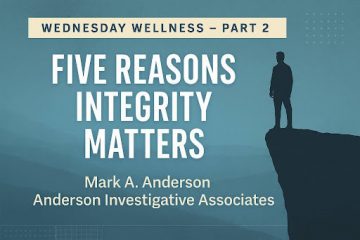
Last week, in Part 1 of this Wednesday Wellness series, we explored the three attributes of integrity; probity, honesty, and contentment, and how they form the foundation of personal steadiness and professional credibility. This week, we shift from the what to the why. Why does integrity matter so much? Why does it influence everything from confidence to leadership to long‑term success?
The answer is simple: integrity is alignment, and alignment is power.
When your values, actions, and identity line up, you become someone others can trust, and someone you can trust. That internal and external trust is the engine behind confidence, resilience, and influence.
Below are five reasons integrity is essential for a healthy, grounded, and successful life, both personally and professionally.
- Integrity Builds a Reputation of Reliability
People rely on those whose actions match their words. Reliability isn’t about perfection; it’s about consistency. When people know what to expect from you, trust forms naturally.
Research on trust formation (Mayer, Davis & Schoorman, 1995) identifies integrity as one of the three core components of trustworthiness, alongside ability and benevolence. In other words, people don’t trust you because you’re skilled or kind alone, they trust you because you’re consistent.
In the practitioner world, interviewing, auditing, supervising, leading, reliability is currency. When your team, your subjects, or your stakeholders know you won’t compromise your values under pressure, they relax. They communicate more openly. They follow your lead.
Integrity makes you predictable in the best possible way.
- Integrity Makes You a Better, More Grounded Person
Integrity isn’t about moral superiority. It’s about internal alignment.
When you live according to your values, you reduce the psychological friction that comes from self‑betrayal. Cognitive dissonance theory (Festinger, 1957) shows that acting against your values creates internal stress, even if no one else knows, you do. Over time, that stress erodes confidence, clarity, and emotional well‑being.
Living with integrity:
- Strengthens your sense of identity
- Reduces internal conflict
- Improves emotional regulation
- Enhances your ability to connect with others
People who live with integrity tend to be more grounded because they’re not constantly managing the tension between who they are and who they pretend to be. It is so hard to be a poser.
Integrity is a wellness practice because it keeps your inner world quiet.
- Integrity Strengthens Confidence
Confidence isn’t built from compliments, achievements, or external validation. It’s built from self‑trust.
When you consistently act in alignment with your values, you begin to trust yourself. You know you’ll follow through. You know you’ll make decisions you can stand behind. You know you won’t abandon your principles when things get uncomfortable.
This is the essence of self‑efficacy, a concept developed by psychologist Albert Bandura. Self‑efficacy is the belief in your ability to act effectively. It grows when your actions reinforce your identity. Integrity fuels that belief.
When you know you’re living truthfully, you walk into rooms differently. You speak differently. You lead differently. You don’t need to posture or perform. You simply show up as yourself.
Confidence is the natural byproduct of integrity.
- Integrity Makes You Admirable and Trustworthy
People admire those who are the same person in every room, on every day, and with every person.
In a world where image consistently outruns character, integrity stands out. It’s rare. It’s refreshing. And it’s magnetic.
Research on social capital shows that people with high integrity attract stronger relationships, deeper trust, and more meaningful collaboration (Putnam, 2000). People want to associate with those who are steady, principled, and authentic.
Integrity also creates psychological safety, the sense that someone is honest, fair, and dependable. This is critically important in leadership and practitioner roles, where people need to feel safe enough to speak truthfully, ask questions, or admit mistakes.
Integrity makes you admirable because it makes you safe.
- Integrity Is the Foundation of Effective Leadership
Leadership without integrity is manipulation. Leadership with integrity is influence.
Research on leadership integrity (Palanski & Yammarino, 2007) shows that leaders who demonstrate consistent moral behavior:
- Inspire higher levels of trust
- Improve team performance
- Increase follower commitment
- Reduce organizational conflict
People follow leaders whose values are visible in their actions. They follow leaders who don’t compromise under pressure. They follow leaders who model the behavior they expect from others.
In practitioner environments, integrity is even more critical. Interviewers, investigators, auditors, and supervisors operate in high‑stakes, high‑ambiguity environments. Integrity becomes the compass that keeps decisions fair, unbiased, and defensible.
When you lead with integrity, you give others permission to do the same. You create a culture where ethics aren’t slogans, they’re habits. Tone at the top is not a buzzword if you adhere to these principles.
Integrity isn’t just a leadership trait. It’s the foundation of leadership itself.
The Wellness Impact: Integrity Reduces Stress and Increases Clarity
When you live with integrity, you eliminate the mental gymnastics that come from hiding, pretending, or rationalizing. You reduce the emotional cost of self‑betrayal. You increase your sense of agency and control.
Integrity simplifies your life.
- It clarifies your decisions.
- It strengthens your relationships.
- It stabilizes your emotions.
- It builds your confidence.
- It protects your reputation.
Integrity is not a moral accessory. It’s a wellness, wellbeing, and resilience strategy.
Reflection Questions for the Week
- Where in my life do I feel the most aligned with my values? Where do I feel the least aligned?
- How does my integrity (or lack of it) impact the people who rely on me?
- What would change in my life if I consistently acted in alignment with my values?
These questions aren’t about guilt. They’re about clarity, and clarity is the beginning of change.
Next Week: How to Strengthen Your Integrity
In Part 3, we’ll examine five practical, actionable strategies to strengthen integrity, habits you can build, behaviors you can practice, and relationships that support your growth.
If Part 1 was the foundation and Part 2 was the impact, Part 3 is the roadmap.
We’re building something meaningful here, let’s take this journey together.
Like much of what I write about training is a first step! It is what has moved me beyond my blind spots (at least some of them). I can provide the training or recommend providers teaching science-based techniques. Do your research, find the right provider, maximize your training dollar investment. If you are a practitioner or a leader, don’t get the same old legacy-based methods that have no empirical evidence supporting them. This is not the time to “do it as we have always done it.” If you are in leadership, you have the same responsibility to know and apply these standards and find that training content that maximizes your team’s effectiveness and accomplishes your mission.
Anderson Investigative Associates is positioned to custom-tailor science-based training to your specific needs. If you have any questions or would like to discuss the subject of this imperative transition, or any training need, please reach out. Additional issues pertaining to interviewing, auditing, and investigations can be found in other blogs and videos that we have produced and are contained in most blocks of instruction that our company presents.
If you have additional questions, comments, or have an interview topic you would like me to address, just let me know. In the meantime, be well, stay safe out there, and start investing in a transition which is ethical and effective. It will improve everything you do. It is time to improve your interviewing and communication skills, and not just in your work but throughout your life. If you need help getting ready, I know who could help.
About the Author: Mark A. Anderson is Director of Training and Development at Anderson Investigative Associates, where he provides training on interview planning, Cognitive Interview techniques, Strategic Use of Evidence, and other science-based interviewing methods.
Contact:
Anderson Investigative Associates, LLC
114 Loucks Avenue
Scottdale, PA 15683
Phone: 912-571-6686
Email: manderson@andersoninvestigative.com
Website: www.AndersonInvestigative.com
LinkedIn: https://www.linkedin.com/in/mark-a-anderson-a46a1658