Anderson Investigative Associates — Navbar

Category: Weekly Edge

Beyond Behavioral Lie Detection: A Complete Framework for Science-Based Credibility Assessment

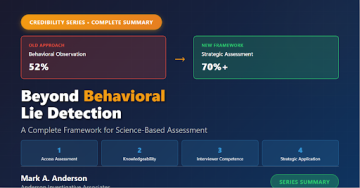
Beyond Behavioral Lie Detection: A Complete Framework for Science-Based Credibility Assessment – Anderson Investigative Over the past four weeks, I’ve explored a fundamental transformation in how we assess credibility during investigative interviews. This series challenged deeply entrenched practices and introduced research-validated alternatives. This article synthesizes those insights into a comprehensive framework that replaces failed behavioral observation with strategic, science-based assessment.

Read More »

How Interviewer Competence Facilitates Disclosure: The Other Side of the Credibility Equation

How Interviewer Competence Facilitates Disclosure: The Other Side of the Credibility Equation – Anderson Investigative In my previous three articles, I demonstrated that behavioral lie detection doesn’t work (achieving only 52% accuracy), then explored Dr. Christian Meissner’s framework for assessing the interviewee’s credibility through access and knowledgeability — questioning whether witnesses could actually observe and understand what they claim. Today,

Read More »

The End of Behavioral Lie Detection: What 50 Years of Research Actually Shows

The End of Behavioral Lie Detection: What 50 Years of Research Actually Shows – Anderson Investigative For decades, investigators have been trained to detect deception by observing behavior: fidgeting hands suggest nervousness, avoiding eye contact indicates dishonesty, crossing arms signals defensiveness, changes in voice pitch reveal lies. We’ve invested countless hours learning to “read” people, studying body language, and analyzing

Read More »

The Planning Imperative: Why Most Interviews Fail and How Science-Based Techniques Demand Preparation

The Planning Imperative: Why Most Interviews Fail and How Science-Based Techniques Demand Preparation – Anderson Investigative Over the past two weeks, I’ve explored the critical — yet criminally neglected — role of planning in investigative interviewing. Research shows that fewer than one in ten interviews receives adequate planning. This dismal statistic explains why so many interviews fail to elicit the

Read More »