From Insight to Practice
Across eight articles, we’ve explored Red Teaming not as a tactical exercise but as a way of living — a mindset that strengthens clarity, steadiness, and integrity. Each piece has revealed a facet of resilience: how we think, how we feel, how we relate, and how we decide. Together, they form a coherent philosophy — one that helps people live with fewer blind spots and more truth.
The purpose of this Capstone is simple: to bring the series home. To remind us that Red Teaming is not something we do; it’s something we become.
The Thread That Connects It All
Every article has carried the same quiet conviction: that strength begins with awareness. When we learn to challenge our own thinking, regulate our emotions, and invite accountability, we become more resilient — not only in crisis but in daily life.
Red Teaming teaches us to pause before reacting, to ask better questions, and to see the world through multiple lenses. It helps us think clearly when life gets loud. It helps us stay steady when emotions surge. It helps us connect more deeply with others because we stop assuming and start understanding.
That is the thread that runs through all eight articles — the movement from reaction to reflection, from certainty to curiosity, from isolation to connection.
The Red Teaming–Wellbeing Model
At the heart of the series lies a unified framework — a way of mapping the four UFMCS principles onto the science of resilience:
- Self-Awareness → Cognitive Resilience
- Applied Critical Thinking → Decision Resilience
- Fostering Cultural Empathy → Relational Resilience
- Groupthink Mitigation → Emotional Resilience
Together, they form a complete system for living with coherence. When we practice these principles consistently, we stop fragmenting ourselves across roles and contexts. We become the same person in every room — clear, steady, and grounded.
That coherence is the essence of wellbeing.
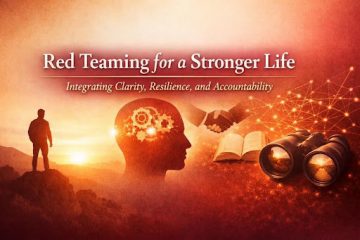
Red Teaming Your Life
The final article in the series turned theory into practice. It invited readers to Red Team their decisions, emotions, and relationships — to treat life itself as a living laboratory for clarity.
It reminded us that accountability is not correction but connection. That challenge networks — friends, mentors, colleagues, faith communities — are the mirrors that keep us honest. That resilience grows not from isolation but from dialogue.
When we Red Team our lives, we stop chasing perfection and start cultivating awareness. We learn to think again — together.
The Human Continuum
Science gives us structure. Strategy gives us discipline. Humanity gives us meaning.
Red Teaming integrates all three. It is the bridge between logic and empathy, between precision and compassion. It reminds us that clarity is not cold; it is kind. It is what allows us to see ourselves and others truthfully.
This is the human continuum — the space where thinking and feeling coexist, where accountability becomes strength, and where resilience becomes a shared practice.
A Call to Practice
If these eight articles have done their work, they have given you more than ideas. They have given you a way to live with coherence.
So take the mindset into your world:
- Red Team your assumptions.
- Red Team your emotions.
- Red Team your relationships.
- Red Team your decisions.
- Red Team your life.
Invite accountability. Seek clarity. Practice steadiness. Live with coherence.
Because Red Teaming is not just a method. It is a way of being — a way of thinking that makes people stronger, relationships deeper, and life more grounded.
Like much of what I write, training is a first step, the one that moved me beyond my own blind spots, at least some of them. I can provide that training or point you toward providers who teach science-based techniques. Do your research. Find the right fit. Make your training dollar count.
Whether you’re a practitioner or a leader, don’t settle for legacy methods with no empirical foundation. This is not the time to “do it as we’ve always done it.” Leadership carries the same responsibility: to know, apply, and demand standards that maximize your team’s effectiveness and advance your mission.
Anderson Investigative Associates custom-tailors science-based training to meet specific needs. If you’d like to discuss this transition, or any training need, reach out. You’ll also find related topics on interviewing, auditing, and investigations in our other blogs, videos, and instructional blocks.
If you have questions, comments, or an interview topic you’d like me to address, let me know. In the meantime, be well, stay safe, and start investing in a transition that is both ethical and effective. It will elevate everything you do. It’s time to strengthen your interviewing and communication skills, not only in your work, but throughout your life. And if you need help getting started, I know who can help.
Further Reading
- Dörner, D. The Logic of Failure: Recognizing and Avoiding Error in Complex Situations. Basic Books, 1996.
- Kahneman, D. Thinking, Fast and Slow. Farrar, Straus and Giroux, 2011.
- Klein, G. Sources of Power: How People Make Decisions. MIT Press, 1998.
- Edmondson, A. The Fearless Organization: Creating Psychological Safety in the Workplace for Learning, Innovation, and Growth. Wiley, 2019.
- Zenko, M. Red Team: How to Succeed by Thinking Like the Enemy. Basic Books, 2015.
- Weick, K. E., & Sutcliffe, K. M. Managing the Unexpected: Sustained Performance in a Complex World. Wiley, 2015.
- Deci, E. L., & Ryan, R. M. Self-Determination Theory. Guilford Press, 2017.
- Fredrickson, B. L. “The Broaden-and-Build Theory of Positive Emotions.” American Psychologist, 2001.
- Heuer, R. J. Psychology of Intelligence Analysis. CIA Center for the Study of Intelligence, 1999.
- UFMCS. The Red Team Handbook, Version 9.0. TRADOC G-2, 2020.
About the Author: Mark A. Anderson is Director of Training and Development at Anderson Investigative Associates, where he provides training on interview planning, Cognitive Interview techniques, Strategic Use of Evidence, and other science-based interviewing methods.
Contact:
Anderson Investigative Associates, LLC
114 Loucks Avenue
Scottdale, PA 15683
Phone: 912-571-6686
Email: manderson@andersoninvestigative.com
Website: www.AndersonInvestigative.com
LinkedIn: https://www.linkedin.com/in/mark-a-anderson-a46a1658