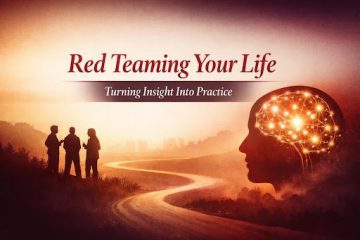
Turning Insight Into Practice
Understanding Red Teaming is valuable. Living it is transformative.
The shift happens when Red Teaming stops being something you “use” and becomes something you are. It becomes a posture — a way of approaching decisions, emotions, and relationships with curiosity rather than certainty. It becomes a habit of asking better questions, especially of yourself.
This is how Red Teaming moves from theory into life.
Begin With Small, Honest Questions
Red Teaming starts in the quiet moments — the pause before a reaction, the breath before a decision, the reflection after a conversation. It begins with simple questions:
What am I assuming? What else could be true? What would I think if I were wrong? What would someone else see that I don’t?
These questions interrupt autopilot. They create space for clarity. They reduce the emotional noise that distorts judgment.
Invite People Who Make You Better
No one Red Teams well alone. We all need people who help us see what we cannot see.
A challenge network is not a group of critics — it is a circle of people who want you to be strong, clear, and honest. They help you test your thinking, check your blind spots, and stay aligned with your values. They make you more resilient because they make you more aware.
Accountability is not about correction. It is about connection.
Red Team Your Decisions
Every meaningful decision carries emotion, risk, and uncertainty. Red Teaming helps you navigate that complexity with steadiness. It teaches you to slow down, examine your logic, and consider the long-term consequences of your choices.
When you Red Team your decisions, you stop reacting and start responding. You stop guessing and start thinking.
Red Team Your Emotions
Emotions are real, but they are not always accurate. Red Teaming helps you treat emotions as data — important, but not definitive.
When you ask yourself what triggered a feeling, what story you’re telling yourself, and what else might be true, you create emotional space. That space is where resilience grows. It is where you regain your footing. It is where you choose your response rather than being driven by it.
Red Team Your Relationships
Relationships thrive when assumptions shrink and understanding expands. Red Teaming helps you interpret others with empathy, curiosity, and generosity. It helps you see the pressures, fears, and histories that shape behavior. It helps you communicate with clarity rather than defensiveness.
When you Red Team your relationships, you strengthen trust — the foundation of every meaningful connection.
A Way of Living, Not a Toolset
Red Teaming reduces stress because it reduces confusion. It increases clarity because it reduces distortion. It strengthens resilience because it strengthens awareness.
When practiced consistently, Red Teaming becomes a way of living — a way of thinking that makes you steadier, clearer, and more grounded in every part of your life.
Like much of what I write, training is a first step, the one that moved me beyond my own blind spots, at least some of them. I can provide that training or point you toward providers who teach science-based techniques. Do your research. Find the right fit. Make your training dollar count.
Whether you’re a practitioner or a leader, don’t settle for legacy methods with no empirical foundation. This is not the time to “do it as we’ve always done it.” Leadership carries the same responsibility: to know, apply, and demand standards that maximize your team’s effectiveness and advance your mission.
Anderson Investigative Associates custom-tailors science-based training to meet specific needs. If you’d like to discuss this transition, or any training need, reach out. You’ll also find related topics on interviewing, auditing, and investigations in our other blogs, videos, and instructional blocks.
If you have questions, comments, or an interview topic you’d like me to address, let me know. In the meantime, be well, stay safe, and start investing in a transition that is both ethical and effective. It will elevate everything you do. It’s time to strengthen your interviewing and communication skills, not only in your work, but throughout your life. And if you need help getting started, I know who can help.
Further Reading
- Dörner, D. The Logic of Failure: Recognizing and Avoiding Error in Complex Situations. Basic Books, 1996.
- Kahneman, D. Thinking, Fast and Slow. Farrar, Straus and Giroux, 2011.
- Klein, G. Sources of Power: How People Make Decisions. MIT Press, 1998.
- Weick, K. E., & Sutcliffe, K. M. Managing the Unexpected: Sustained Performance in a Complex World. Wiley, 2015.
- Edmondson, A. The Fearless Organization: Creating Psychological Safety in the Workplace for Learning, Innovation, and Growth. Wiley, 2019.
- Fredrickson, B. L. “The broaden-and-build theory of positive emotions.” American Psychologist, 2001.
- Gross, J. J. “Emotion regulation: Affective, cognitive, and social consequences.” Psychophysiology, 2002.
- Deci, E. L., & Ryan, R. M. Self-Determination Theory. Guilford Press, 2017.
- Baxter Magolda, M. B. Self-Authorship: Advancing Students’ Intellectual Growth. Jossey-Bass, 2001.
- UFMCS. The Red Team Handbook, Version 9.0. TRADOC G-2, 2020.
- UFMCS. Applied Critical Thinking Handbook.
- Heuer, R. J. Psychology of Intelligence Analysis. CIA Center for the Study of Intelligence, 1999.
- Zenko, M. Red Team: How to Succeed by Thinking Like the Enemy. Basic Books, 2015.
- Tetlock, P. E., & Gardner, D. Superforecasting: The Art and Science of Prediction. Crown, 2015.
- Shepherd, E., & Griffiths, A. Investigative Interviewing: The Conversation Management Approach. Oxford University Press, 2013.
- Meissner, C. A., & Russano, M. B. “The psychology of interrogations and confessions.” Annual Review of Law and Social Science, 2007.
- Gross, J. J., & John, O. P. “Individual differences in two emotion regulation processes: Implications for affect, relationships, and well-being.” Journal of Personality and Social Psychology, 2003.
About the Author: Mark A. Anderson is Director of Training and Development at Anderson Investigative Associates, where he provides training on interview planning, Cognitive Interview techniques, Strategic Use of Evidence, and other science-based interviewing methods.
Contact:
Anderson Investigative Associates, LLC
114 Loucks Avenue
Scottdale, PA 15683
Phone: 912-571-6686
Email: manderson@andersoninvestigative.com
Website: www.AndersonInvestigative.com
LinkedIn: https://www.linkedin.com/in/mark-a-anderson-a46a1658