The Human Element in Investigation
Every interview is a meeting between two human beings, each carrying their own experiences, assumptions, and emotions into the room. The interviewer seeks truth, but truth is rarely simple. It hides behind perception, memory, fear, and bias. The quality of an interview depends not only on technique but on the interviewer’s ability to think clearly, remain grounded, and adapt to complexity. That is where Red Teaming becomes indispensable.
Red Teaming was designed to help people think better under pressure. It teaches the discipline of slowing down, questioning assumptions, and seeing situations from multiple perspectives. Those same skills define effective interviewing. They transform the process from interrogation into understanding.
Cognitive Flexibility and Emotional Steadiness
Investigative interviewing demands cognitive flexibility — the ability to shift perspectives without losing focus. Interviewers must hold multiple possibilities at once, interpret incomplete information, and remain open to being wrong. Red Teaming cultivates that flexibility. It trains the mind to move between frames, to challenge its own conclusions, and to remain curious even when the answer seems obvious.
Emotional steadiness is equally vital. Interviews often involve tension, uncertainty, and emotional weight. Red Teaming’s emphasis on self-awareness and reflection helps interviewers recognize their own emotional responses before those responses shape their behavior. It teaches them to pause, to breathe, and to choose clarity over reaction. That steadiness protects both the interviewer and the integrity of the process.
Bias, Assumption, and the Search for Truth
The Red Team Handbook warns that people court failure in predictable ways — by relying on shortcuts, ignoring ambiguity, and assuming they understand more than they do. In interviewing, those same tendencies lead to confirmation bias and premature closure. We hear what we expect to hear. We stop listening when the story fits our theory. We mistake confidence for accuracy.
Red Teaming counters those patterns by teaching structured skepticism. It encourages interviewers to ask, What else could this mean? and What assumptions am I making right now? It replaces judgment with curiosity. It turns the search for truth into a disciplined act of reflection.
Empathy and Connection
Fostering Cultural Empathy, one of the core principles of Red Teaming, is central to interviewing. It reminds us that every person’s behavior is shaped by culture, context, and experience. When interviewers approach others with genuine curiosity, they create space for honesty. Empathy does not mean agreement; it means understanding. It allows interviewers to interpret responses through the lens of human complexity rather than personal bias.
Empathy also protects wellbeing. Interviewers who can connect without absorbing the emotional weight of the interaction maintain their own resilience. They leave the room steadier, clearer, and more capable of continuing the work.
A Discipline That Strengthens Both Sides of the Table
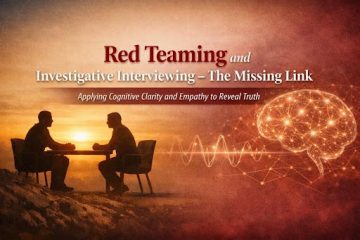
Red Teaming and investigative interviewing share a common purpose: to reveal truth through disciplined thinking. Both require humility, patience, and accountability. Both depend on the willingness to challenge assumptions and to listen deeply. When interviewers adopt Red Team principles, they not only improve the quality of their investigations — they strengthen their own wellbeing. They learn to think with clarity, act with empathy, and recover with resilience.
In the end, Red Teaming is not just a method. It is a mindset. It is the missing link between cognitive precision and human understanding. It is how we make better decisions, conduct better interviews, and live with greater steadiness in a complex world.
Like much of what I write, training is a first step, the one that moved me beyond my own blind spots, at least some of them. I can provide that training or point you toward providers who teach science-based techniques. Do your research. Find the right fit. Make your training dollar count.
Whether you’re a practitioner or a leader, don’t settle for legacy methods with no empirical foundation. This is not the time to “do it as we’ve always done it.” Leadership carries the same responsibility: to know, apply, and demand standards that maximize your team’s effectiveness and advance your mission.
Anderson Investigative Associates custom-tailors science-based training to meet specific needs. If you’d like to discuss this transition, or any training need, reach out. You’ll also find related topics on interviewing, auditing, and investigations in our other blogs, videos, and instructional blocks.
If you have questions, comments, or an interview topic you’d like me to address, let me know. In the meantime, be well, stay safe, and start investing in a transition that is both ethical and effective. It will elevate everything you do. It’s time to strengthen your interviewing and communication skills, not only in your work, but throughout your life. And if you need help getting started, I know who can help.
Further Reading
- Dörner, D. The Logic of Failure: Recognizing and Avoiding Error in Complex Situations. Basic Books, 1996.
- Kahneman, D. Thinking, Fast and Slow. Farrar, Straus and Giroux, 2011.
- Klein, G. Sources of Power: How People Make Decisions. MIT Press, 1998.
- Weick, K. E., & Sutcliffe, K. M. Managing the Unexpected: Sustained Performance in a Complex World. Wiley, 2015.
- Edmondson, A. The Fearless Organization: Creating Psychological Safety in the Workplace for Learning, Innovation, and Growth. Wiley, 2019.
- Fredrickson, B. L. “The broaden‑and‑build theory of positive emotions.” American Psychologist, 2001.
- Gross, J. J. “Emotion regulation: Affective, cognitive, and social consequences.” Psychophysiology, 2002.
- Deci, E. L., & Ryan, R. M. Self‑Determination Theory. Guilford Press, 2017.
- Baxter Magolda, M. B. Self‑Authorship: Advancing Students’ Intellectual Growth. Jossey‑Bass, 2001.
- UFMCS. The Red Team Handbook, Version 9.0. TRADOC G‑2, 2020.
- UFMCS. Applied Critical Thinking Handbook.
- Heuer, R. J. Psychology of Intelligence Analysis. CIA Center for the Study of Intelligence, 1999.
- Zenko, M. Red Team: How to Succeed by Thinking Like the Enemy. Basic Books, 2015.
- Tetlock, P. E., & Gardner, D. Superforecasting: The Art and Science of Prediction. Crown, 2015.
- Shepherd, E., & Griffiths, A. Investigative Interviewing: The Conversation Management Approach. Oxford University Press, 2013.
- Vrij, A. Detecting Lies and Deceit: Pitfalls and Opportunities. Wiley, 2008.
- Meissner, C. A., & Russano, M. B.“The psychology of interrogations and confessions.” Annual Review of Law and Social Science, 2007.
About the Author: Mark A. Anderson is Director of Training and Development at Anderson Investigative Associates, where he provides training on interview planning, Cognitive Interview techniques, Strategic Use of Evidence, and other science-based interviewing methods.
Contact:
Anderson Investigative Associates, LLC
114 Loucks Avenue
Scottdale, PA 15683
Phone: 912-571-6686
Email: manderson@andersoninvestigative.com
Website: www.AndersonInvestigative.com
LinkedIn: https://www.linkedin.com/in/mark-a-anderson-a46a1658