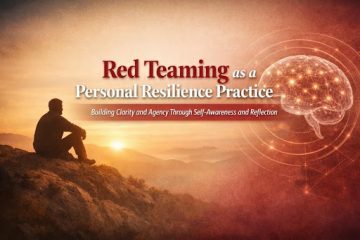
The Inner Landscape of Decision-Making
Every decision we make begins inside us. It starts with the quiet interplay of memory, emotion, and belief. We like to think our choices are rational, but most of them are shaped by patterns we learned long before we were aware of them. Those patterns help us move through life efficiently, yet they also limit us. They tell us what is safe, what is familiar, and what is possible. When we rely on them without reflection, they become invisible boundaries around our thinking.
Red Teaming invites us to see those boundaries. It asks us to pause long enough to notice the assumptions that guide our decisions. It asks us to look inward with the same curiosity we bring to external problems. It reminds us that clarity begins with self-awareness.
Self-Awareness and Reflection
The University of Foreign Military and Cultural Studies calls this first principle Self-Awareness and Reflection. It is the foundation of every other skill. Without it, we cannot recognize the biases that shape our perception or the emotions that color our judgment. Self-awareness is not self-criticism. It is the ability to observe our own thinking with honesty and compassion. It is the discipline of slowing down, of asking why we believe what we believe, and of understanding how our experiences influence our choices.
When we practice this kind of reflection, we begin to see the difference between reaction and intention. We notice when we are acting from habit rather than purpose. We learn to separate the noise of urgency from the signal of clarity. That awareness is the first step toward resilience.
The Science of Reflection and Resilience
Psychology has long recognized that self-awareness and emotional regulation are central to wellbeing. Research on cognitive flexibility, mindfulness, and emotional intelligence all point to the same conclusion: people who can observe their own thoughts without judgment recover more quickly from stress and adapt more effectively to change. They experience less burnout, make better decisions, and maintain stronger relationships.
Red Teaming translates those findings into practice. It gives people structured ways to examine their thinking, challenge their assumptions, and reframe their understanding. It turns reflection into a skill rather than a vague aspiration. It teaches the mind to slow down, to question, and to choose deliberately.
From Self-Awareness to Agency
Resilience is not about endurance. It is about agency. It is the belief that we can influence our circumstances even when we cannot control them. Red Teaming strengthens that belief because it teaches us to engage with uncertainty rather than avoid it. When we learn to challenge our own thinking, we discover that we are not powerless in the face of complexity. We can choose how we interpret events. We can choose how we respond. We can choose to act with clarity rather than fear.
That sense of agency is what allows people to remain steady under pressure. It is what allows interviewers, leaders, and everyday professionals to navigate ambiguity without losing their center. It is what allows us to live with consistency across every part of our lives.
A Practice for Everyday Life
Red Teaming as a personal resilience practice does not require a classroom or a formal exercise. It begins with small moments of awareness. It begins with asking, What assumptions am I making right now? It begins with noticing when emotion is driving a decision that should be guided by reason. It begins with inviting accountability from the people we trust. Over time, those small moments accumulate into a way of living that is more deliberate, more grounded, and more resilient.
When we learn to Red Team ourselves, we become less reactive and more reflective. We become more capable of seeing situations clearly. We become more consistent in how we approach life, work, and relationships. And we begin to experience the quiet strength that comes from knowing our own mind.
Like much of what I write, training is a first step, the one that moved me beyond my own blind spots, at least some of them. I can provide that training or point you toward providers who teach science-based techniques. Do your research. Find the right fit. Make your training dollar count.
Whether you’re a practitioner or a leader, don’t settle for legacy methods with no empirical foundation. This is not the time to “do it as we’ve always done it.” Leadership carries the same responsibility: to know, apply, and demand standards that maximize your team’s effectiveness and advance your mission.
Anderson Investigative Associates custom-tailors science-based training to meet specific needs. If you’d like to discuss this transition, or any training need, reach out. You’ll also find related topics on interviewing, auditing, and investigations in our other blogs, videos, and instructional blocks.
If you have questions, comments, or an interview topic you’d like me to address, let me know. In the meantime, be well, stay safe, and start investing in a transition that is both ethical and effective. It will elevate everything you do. It’s time to strengthen your interviewing and communication skills, not only in your work, but throughout your life. And if you need help getting started, I know who can help.
Further Reading
- Dörner, D. The Logic of Failure: Recognizing and Avoiding Error in Complex Situations. Basic Books, 1996.
- Kahneman, D. Thinking, Fast and Slow. Farrar, Straus and Giroux, 2011.
- Klein, G. Sources of Power: How People Make Decisions. MIT Press, 1998.
- Weick, K. E., & Sutcliffe, K. M. Managing the Unexpected: Sustained Performance in a Complex World. Wiley, 2015.
- Edmondson, A. The Fearless Organization: Creating Psychological Safety in the Workplace for Learning, Innovation, and Growth. Wiley, 2019.
- Fredrickson, B. L. “The broaden-and-build theory of positive emotions.” American Psychologist, 2001.
- Gross, J. J. “Emotion regulation: Affective, cognitive, and social consequences.” Psychophysiology, 2002.
- Deci, E. L., & Ryan, R. M. Self-Determination Theory. Guilford Press, 2017.
- Baxter Magolda, M. B. Self-Authorship: Advancing Students’ Intellectual Growth. Jossey-Bass, 2001.
- UFMCS. The Red Team Handbook, Version 9.0. TRADOC G-2, 2020.
- UFMCS. Applied Critical Thinking Handbook.
- Heuer, R. J. Psychology of Intelligence Analysis. CIA Center for the Study of Intelligence, 1999.
- Zenko, M. Red Team: How to Succeed by Thinking Like the Enemy. Basic Books, 2015.
- Tetlock, P. E., & Gardner, D. Superforecasting: The Art and Science of Prediction. Crown, 2015.
About the Author: Mark A. Anderson is Director of Training and Development at Anderson Investigative Associates, where he provides training on interview planning, Cognitive Interview techniques, Strategic Use of Evidence, and other science-based interviewing methods.
Contact:
Anderson Investigative Associates, LLC
114 Loucks Avenue
Scottdale, PA 15683
Phone: 912-571-6686
Email: manderson@andersoninvestigative.com
Website: www.AndersonInvestigative.com
LinkedIn: https://www.linkedin.com/in/mark-a-anderson-a46a1658