The Quiet Patterns of Human Error
There is a quiet truth about human behavior that most of us would rather not admit. We do not fail because we are careless or unmotivated. We fail because we are human. We fail in patterns. We fail in ways that are so predictable that psychologists have been mapping them for decades. And we fail most often when we believe we are thinking clearly.
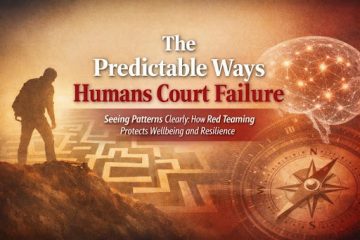
Dietrich Dörner wrote that people court failure in small steps, almost imperceptibly, and always within the logic of their own culture and context. That idea has stayed with me because it captures something we all experience. We rarely make one catastrophic mistake. Instead, we make a series of small decisions that feel reasonable in the moment. We rely on shortcuts that once served us well. We assume we understand more than we do. We trust our instincts even when the situation demands something more deliberate. And by the time we realize we have drifted off course, the consequences are already unfolding.
How Groups Amplify Human Tendencies
The Red Team Handbook describes these tendencies with a clarity that is hard to ignore. It explains how we take comfort in the familiar, how we turn away from ambiguity, how we rely on past experience even when the present moment is different, and how we avoid challenging the assumptions that sit beneath our decisions. It describes how groups amplify these tendencies. A room full of smart people can still talk themselves into a bad plan because no one wants to disrupt the momentum. Silence becomes agreement. Confidence becomes evidence. Familiarity becomes truth.
These patterns do not only shape military planning rooms. They shape families, friendships, workplaces, and interview rooms. They shape the way we interpret the behavior of others. They shape the way we respond to stress. They shape the way we make sense of uncertainty. And they shape the way we relate to ourselves.
The Cost of Cognitive Shortcuts
When we rely on these shortcuts, we create unnecessary strain. We carry the weight of decisions that were never fully examined. We experience stress that could have been avoided. We misread situations and then blame ourselves for not seeing what was never actually clear. We create tension in relationships because we assume intentions rather than explore them. We move through life with a sense of pressure that comes not from the world itself but from the way we interpret it.
Red Team Thinking as Cognitive Hygiene
This is where Red Team thinking becomes more than a decision tool. It becomes a wellbeing tool. It gives us a way to interrupt the predictable patterns that lead to unnecessary stress. It gives us a way to slow down long enough to see what is actually happening rather than what we assume is happening. It gives us a way to question our own thinking without judgment. It gives us a way to invite others into that process so that accountability becomes a source of strength rather than a source of fear.
When we challenge our assumptions, we reduce the emotional load that comes from acting on incomplete information. When we examine our own thinking, we create space between stimulus and response. When we allow others to question us, we strengthen the relationships that support us. When we learn to see situations from multiple perspectives, we become more adaptable and less reactive. These are the foundations of resilience.
The Interview Room as a Mirror
In investigative interviewing, these patterns are even more pronounced. Interviewers who rely on instinct alone are more vulnerable to confirmation bias, premature closure, and emotional reactivity. They may feel confident in the moment, but confidence is not clarity. The interviewers who thrive are the ones who can pause, reflect, and reconsider. They are the ones who can hold uncertainty without rushing to resolve it. They are the ones who can recognize when their own assumptions are shaping the interaction. Red Teaming strengthens those capacities because it teaches people to think with intention rather than habit.
Choosing a Different Path
The truth is that humans will always court failure in predictable ways. That is not a flaw. It is part of being human. The question is whether we allow those patterns to guide us or whether we learn to see them clearly enough to choose a different path. Red Teaming gives us that choice. It gives us a way to think that protects our wellbeing, strengthens our relationships, and increases our resilience.
And it reminds us that clarity is not something we stumble into. It is something we build.
Like much of what I write, training is a first step, the one that moved me beyond my own blind spots, at least some of them. I can provide that training or point you toward providers who teach science-based techniques. Do your research. Find the right fit. Make your training dollar count.
Whether you’re a practitioner or a leader, don’t settle for legacy methods with no empirical foundation. This is not the time to “do it as we’ve always done it.” Leadership carries the same responsibility: to know, apply, and demand standards that maximize your team’s effectiveness and advance your mission.
Anderson Investigative Associates custom-tailors science-based training to meet specific needs. If you’d like to discuss this transition, or any training need, reach out. You’ll also find related topics on interviewing, auditing, and investigations in our other blogs, videos, and instructional blocks.
If you have questions, comments, or an interview topic you’d like me to address, let me know. In the meantime, be well, stay safe, and start investing in a transition that is both ethical and effective. It will elevate everything you do. It’s time to strengthen your interviewing and communication skills, not only in your work, but throughout your life. And if you need help getting started, I know who can help.
Further Reading
- Dörner, D. The Logic of Failure: Recognizing and Avoiding Error in Complex Situations. Basic Books, 1996.
- Kahneman, D. Thinking, Fast and Slow. Farrar, Straus and Giroux, 2011.
- Klein, G. Sources of Power: How People Make Decisions. MIT Press, 1998.
- Weick, K. E., & Sutcliffe, K. M. Managing the Unexpected: Sustained Performance in a Complex World. Wiley, 2015.
- Edmondson, A. The Fearless Organization: Creating Psychological Safety in the Workplace for Learning, Innovation, and Growth. Wiley, 2019.
- Fredrickson, B. L. “The broaden-and-build theory of positive emotions.” American Psychologist, 2001.
- Gross, J. J. “Emotion regulation: Affective, cognitive, and social consequences.” Psychophysiology, 2002.
- Deci, E. L., & Ryan, R. M. Self-Determination Theory. Guilford Press, 2017.
- UFMCS. The Red Team Handbook, Version 9.0. TRADOC G-2, 2020.
- U.S. Army TRADOC. Red Teaming Guide. TRADOC G-2.
- UFMCS. Applied Critical Thinking Handbook.
- Heuer, R. J. Psychology of Intelligence Analysis. CIA Center for the Study of Intelligence, 1999.
- Zenko, M. Red Team: How to Succeed by Thinking Like the Enemy. Basic Books, 2015.
- Tetlock, P. E., & Gardner, D. Superforecasting: The Art and Science of Prediction. Crown, 2015.
About the Author: Mark A. Anderson is Director of Training and Development at Anderson Investigative Associates, where he provides training on interview planning, Cognitive Interview techniques, Strategic Use of Evidence, and other science-based interviewing methods.
Contact:
Anderson Investigative Associates, LLC
114 Loucks Avenue
Scottdale, PA 15683
Phone: 912-571-6686
Email: manderson@andersoninvestigative.com
Website: www.AndersonInvestigative.com
LinkedIn: https://www.linkedin.com/in/mark-a-anderson-a46a1658