Integrity is one of those words we all nod along to, but few people slow down long enough to examine what it actually means in practice. We talk about it as if it’s a fixed trait, something you either have or don’t, when in reality, integrity is a daily discipline. It’s a wellness practice. It’s a leadership practice. And it’s a human practice.
When we drift from our values, even in small ways, we feel it. There’s a quiet tension that shows up in the body: a tightening in the chest, a restless mind, a sense that something is “off.” Psychologists call this cognitive dissonance, the discomfort we feel when our actions don’t align with our beliefs (Festinger, 1957). Most people try to ignore that feeling or beat it down. Practitioners, leaders, and anyone responsible for the well‑being of others can’t afford to.
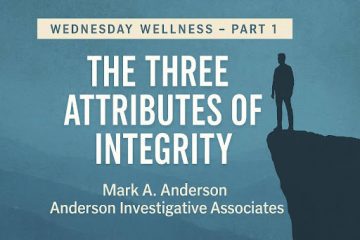
That’s why this month’s Wednesday Wellness series is dedicated to integrity, what it is, why it matters, and how to strengthen it. Today, in Part 1, we’re laying the foundation: the three attributes that make integrity visible, measurable, and livable.
These attributes: probity, honesty, and contentment. They aren’t abstract ideals. They’re behaviors. They’re choices. And they’re the backbone of trust, credibility, and personal steadiness.
Integrity as a Wellness Practice
Before we break down the attributes, it’s worth naming why integrity belongs in a wellness series at all.
When your actions align with your values:
- Your stress decreases
- Your confidence increases
- Your relationships strengthen
- Your decision-making becomes clearer
- Your internal world becomes quieter
Research in Self-Determination Theory (Deci & Ryan, 2000) shows that authenticity, acting in alignment with one’s values, is a core driver of psychological well‑being. When we live out of sync with our values, we experience internal friction. When we live in alignment, we experience ease.
Integrity isn’t just moral. It’s physiological.
The Three Attributes of Integrity
- Probity: Ethical Consistency in Action
Probity is the quiet, steady behavior that tells people, “You can trust me because I act with fairness and principle, even when no one is watching.” And I do it consistently.
It’s not dramatic. It’s not performative. It’s the day‑to‑day discipline of doing what’s right, not what’s convenient.
In the field, whether interviewing, auditing, supervising, or leading, probity is what keeps drift at bay. It’s what prevents shortcuts, bias, and rationalizations. It’s what allows others to rely on your judgment. It’s what makes the slippery slope, not so slick.
Research backs this up. In the well‑known Model of Trustworthiness (Mayer, Davis & Schoorman, 1995), integrity is one of the three pillars that determine whether people trust you. Not charisma. Not authority. Integrity.
Probity is the behavioral and operational expression of that integrity.
In practice, probity looks like:
- Following the same standards when the stakes are low as when they’re high
- Making decisions you can defend tomorrow
- Being consistent in your expectations of yourself and others
- Avoiding the “just this once” trap
Probity is the anchor. Without it, everything else drifts.
- Honesty: Truthfulness in Word and Conduct
Honesty is more than telling the truth. It’s living the truth.
It’s the alignment between what you say, what you do, and who you are. It’s the absence of manipulation, distortion, or self‑deception. And it’s one of the most powerful confidence builders a person can cultivate.
When people lie, even small lies, the brain has to work harder. It must track the story, manage the inconsistencies, and protect the falsehood. This increases cognitive load and stress. Research on deception consistently shows that dishonesty creates measurable psychological strain (Vrij, 2008).
Honesty, on the other hand, reduces that strain. It frees up mental bandwidth. It stabilizes your presence. It allows you to show up fully.
In practice, honesty looks like:
- Saying what you mean and meaning what you say
- Owning mistakes without defensiveness
- Being transparent about your intentions
- Refusing to misrepresent yourself to gain approval
Honesty is the attribute that makes people feel safe around you. It’s the structural foundation of credibility.
- Contentment: The Groundedness That Prevents Compromise
Contentment is the most misunderstood attribute of integrity.
People often confuse contentment with complacency. But contentment isn’t about settling. It’s about being grounded enough in who you are and what you have, that you don’t feel pressured to cut corners, cheat, or chase validation.
Contentment is psychological steadiness.
Research in positive psychology shows that contentment increases emotional regulation and reduces impulsive decision-making (Eisenblatt, 2002). When you’re content, you’re less likely to compromise your values for short-term gain because you’re not operating from scarcity. This is a significant subject in today’s culture that needs self-reflection.
In practice, contentment looks like:
- Being grateful for what you have without losing ambition
- Making decisions from clarity rather than insecurity
- Staying grounded when others are reactive
- Choosing long-term integrity over short-term advantage
Contentment is what keeps integrity from being situational. It makes it sustainable.
Why These Attributes Matter
When probity, honesty, and contentment work together, something powerful happens:
You become the same person in every room, in every environment, in every day.
People know what to expect from you. You know what to expect from yourself. And that consistency becomes a source of confidence, credibility, and calm.
Integrity isn’t perfection. It’s alignment. And alignment is a foundational wellness practice.
Reflection Questions for the Week
- Where in my life do my actions drift from my values, even subtly?
- Which attribute: probity, honesty, or contentment, comes most naturally to me? Which requires more intentional effort?
- How does my integrity impact the people who rely on me?
These questions aren’t about judgment. They’re about awareness, the first step toward strengthening integrity. I reflect on these questions weekly. We have to see the drift early.
Next Week: Why Integrity Matters More Than Ever
In Part 2 of this series, we’ll explore the impact of integrity on confidence, leadership, relationships, and long-term success. If Part 1 is the foundation, Part 2 is the “why” behind it.
Integrity is a practice. And we’re just getting started.
Like much of what I write about training is a first step! It is what has moved me beyond my blind spots (at least some of them). I can provide the training or recommend providers teaching science-based techniques. Do your research, find the right provider, maximize your training dollar investment. If you are a practitioner or a leader, don’t get the same old legacy-based methods that have no empirical evidence supporting them. This is not the time to “do it as we have always done it.” If you are in leadership, you have the same responsibility to know and apply these standards and find that training content that maximizes your team’s effectiveness and accomplishes your mission.
Anderson Investigative Associates is positioned to custom-tailor science-based training to your specific needs. If you have any questions or would like to discuss the subject of this imperative transition, or any training need, please reach out. Additional issues pertaining to interviewing, auditing, and investigations can be found in other blogs and videos that we have produced and are contained in most blocks of instruction that our company presents.
If you have additional questions, comments, or have an interview topic you would like me to address, just let me know. In the meantime, be well, stay safe out there, and start investing in a transition which is ethical and effective. It will improve everything you do. It is time to improve your interviewing and communication skills, and not just in your work but throughout your life. If you need help getting ready, I know who could help.
About the Author: Mark A. Anderson is Director of Training and Development at Anderson Investigative Associates, where he provides training on interview planning, Cognitive Interview techniques, Strategic Use of Evidence, and other science-based interviewing methods.
Contact:
Anderson Investigative Associates, LLC
114 Loucks Avenue
Scottdale, PA 15683
Phone: 912-571-6686
Email: manderson@andersoninvestigative.com
Website: www.AndersonInvestigative.com
LinkedIn: https://www.linkedin.com/in/mark-a-anderson-a46a1658